
Membership Tier Pricing Lessons From The Independent
Good membership tier pricing starts before a reader ever sees a price. Across nine Leaky Paywall publishers, a registration wall after one free article converted 3.2% to 6.7% of readers who saw it, two to seven times what a newsletter popup collects. That free account is your first tier. Here's how to build the paid rungs above it, using The Independent's two-tier membership as a model: a core tier readers stay for, annual as the default, and a top tier built from work you already make. Plus how Small Boats Monthly turned nearly 30% of free registrations into paid subscribers, and how many cards belong on your pricing page.

Publisher Summary
Good membership tier pricing starts before a reader ever sees a price. Across nine Leaky Paywall publishers, a registration wall after one free article converted 3.2% to 6.7% of readers who saw it, versus 0.9% to 1.45% for newsletter popups.
That free account is your first tier. The Independent, profitable nine years running, shows what the paid rungs above it can look like: perks readers stay for, an annual default, and a top tier built from work the newsroom already does.
The Independent replaced its old Independent Premium subscription with two membership tiers built around perks readers use every week. Per Press Gazette, the company has more than doubled its revenue to £55.1 million and stayed profitable nine years running.
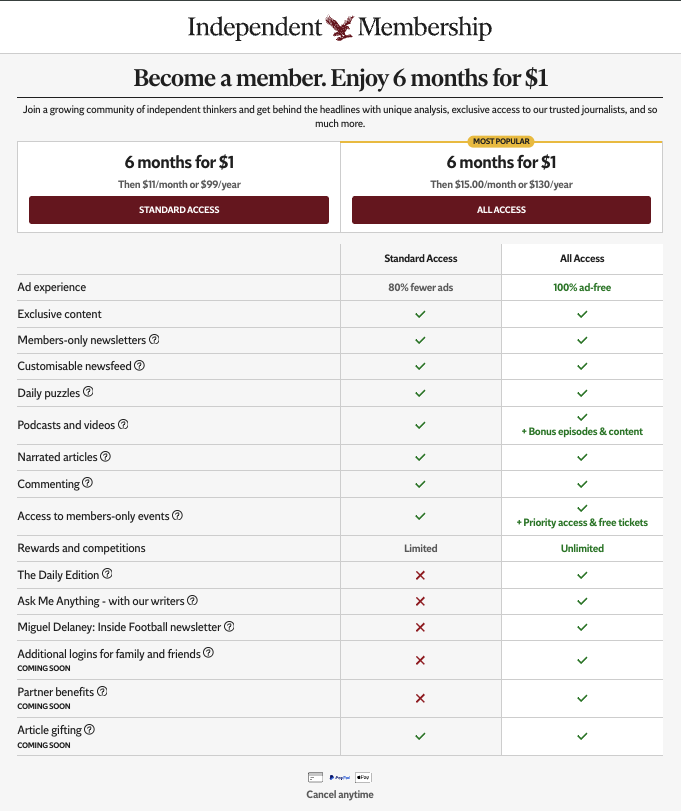
You don’t need a national newsroom to borrow the structure. Its membership works like a ladder readers climb one rung at a time, and you can build the same ladder at your size. The first rung is free.
Rung One: Free Registration Is a Tier
Your first tier costs nothing, and you should still require it.
Give one free article, then require registration to keep reading. That’s the setup behind the 3.2% to 6.7% range above: two to seven times what a popup collects.
A popup only asks. A registration wall requires.
A free tier can feel like giving your work away. But the reader pays with an email, and that email is the asset you build every paid tier on. Many of our publishers run this with Leaky Paywall’s List Builder.
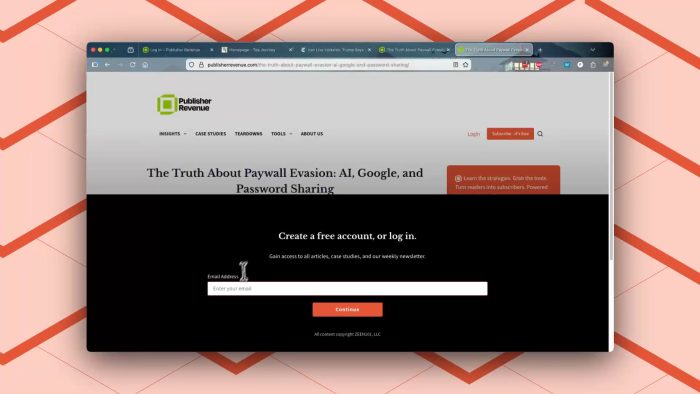
Registered readers are far more likely to pay. Piano’s benchmark data shows cold paywalls converting 0.22% of readers, versus 9.88% for registered users. That’s up to 45x.
Small Boats Monthly, a subscription magazine about small boats from the publishers of WoodenBoat, shows how fast this rung pays off. Its audience grew 20% in the first 30 days after it added a registration wall. And nearly 30% of its free registrations converted to paid.
Its welcome sequence is a single email. A visual HTML email sent 60 minutes after signup converts 5x higher than any other source Small Boats tracks.
Give registered readers something real for their email: an extra article or two a month and your free newsletter.
Rung Two: One Core Membership Readers Stay For
Your core tier needs to give readers a reason to stay during a slow news week.
Access alone is a weak reason to renew. When nothing big happens, readers start asking what they’re paying for.
The Independent’s answer is a bundle of habits. Per Press Gazette, its Standard tier costs £11 a month or £99 a year and includes member-only content, newsletters, events, puzzles, commenting, a personalized feed, and fewer ads.
Those habits matter more as search gets less reliable. Per Press Gazette, The Independent’s UK online readership fell 14% year on year, while AI revenue grew from zero to 7% of its total.
When The Independent launched an earlier loyalty tier, Independent Minds, then-editor Christian Broughton told Journalism.co.uk: “We learned not to treat everybody the same, and to listen.”
Your newsletter is your product. Across the publishers we work with, daily senders see up to 4x the paid conversions. Keep your free and paid newsletters separate: the free one is your sales tool, and the paid one is pure value.
A solid core tier looks like this: your original articles, a paid newsletter, commenting, and a cleaner page. If your model allows it, drop ads for paying members entirely. Ads on a page someone paid for cheapen the subscription.
Rung Three: Make Annual the Default
Annual is where your revenue should land.
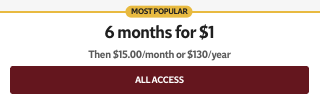
The Independent’s annual plans save members about 25% on Standard and about 28% on All-Access. You don’t need to discount that much. We recommend 15% to 20% off the monthly price.
Lead with annual on your pricing page and label it “Most Popular.” Annual subscribers churn less than monthly ones.
You can go further. One publisher we work with showed only annual plans on its public pricing page and brought in about €3,000 in 3.5 weeks.
Keep monthly in your back pocket. Use it as a targeted offer for engaged free readers and cart abandoners.
Rung Four: A Top Tier Built From Work You Already Do
Your top tier should package work you already make.
The Independent’s All-Access tier costs £15 a month or £130 a year. It adds a digital edition of the newspaper and ask-me-anything Q&A videos, both built on work its newsroom already produces.
Look at what you already have: a PDF replica of your issue, a print archive, a monthly reader Q&A, members-only video. Any of these can anchor a top tier. Reissue turns issue PDFs into WordPress article drafts, so your back catalog can become a searchable archive.
You can test demand before you build anything. One local publisher emailed subscribers a single question: would you upgrade from $10 to $20 as a “super supporter”? The publisher upgraded every yes by hand.
More than 100 of roughly 1,200 to 1,500 subscribers said yes, adding over $1,000 in monthly recurring revenue. Across the publishers we work with, concierge upgrade campaigns like this draw about a 7% to 8% response.
Your third option doesn’t have to be a premium tier. It can be gift subscriptions, group access for businesses, or donations if you’re mission-driven.
In print, a healthy benchmark is gifts making up 20% of paid subscribers. If you’re far below that, promote gifts, especially around the holidays.
How Many Membership Tiers Should You Offer?
Three cards on your pricing page is plenty.
Show your core membership led by annual, your top tier, and a third option like gifts or group access. Four or more choices lead to decision fatigue.
Free registration doesn’t need a card. It lives at the wall, where readers meet it after their first article.
Key Takeaways
- Free registration is your first tier. One free article followed by a required email converts two to seven times more readers than a popup.
- Your core tier sells belonging. Newsletters, comments, puzzles and events give readers a reason to stay during slow news weeks.
- Lead with annual and mark it “Most Popular.” A 15% to 20% discount is enough. Keep monthly as a targeted offer.
- Build your top tier from work you already make, and test demand with a simple upgrade email before you build anything new.
- Show three cards at most on your pricing page. Your third card can be gifts, group access or donations instead of a premium tier.
Try This Week
Email your current subscribers one question: would they upgrade to a higher price as a “super supporter”? Upgrade every yes by hand and count the replies. Use that number to decide whether a top tier is worth building.
Resources Mentioned
