
Your Subscription Checkout Is Losing Readers Who Already Said Yes
A reader who clicks Subscribe has already decided to pay. Across the publishers we work with, platforms that sit between you and Stripe lose 6% to 10% of subscribers a year to failed payments, versus 4% to 7% on native Stripe. The first checkout leaks too: a study of more than 500 US newspapers found over 90% of readers who started a subscription purchase didn't finish. This piece shows where your checkout loses readers who already said yes, how a registration wall turns checkout into an upgrade, why Northshore Magazine's login page became its top revenue source in 30 days, and a five-minute audit you can run today.

Publisher Summary
Your payment setup decides how many readers you keep after they say yes. Across the publishers we work with, platforms that sit between you and Stripe lose 6% to 10% of subscribers a year to failed payments. Native Stripe subscriptions lose 4% to 7%.
The first checkout leaks too. Baymard Institute puts average checkout abandonment at about 70% across 50 studies. A study of more than 500 US newspapers found over 90% of readers who started a subscription purchase didn’t finish.
Below: where readers drop out, what to fix, and a five-minute audit you can run today.
The Reader at Checkout Has Already Said Yes
Every reader you lose at checkout is a sale you’d already made.
By the time someone reaches your checkout, they’ve read your work, hit your wall, compared your plans, and clicked a button. That’s the hard part of the funnel, and it’s done.
Baymard’s numbers come mostly from online retail, and the publishing data looks no better. The Shorenstein Center and Lenfest Institute studied more than 500 US newspapers and found over 90% of readers who started a subscription purchase dropped out before the last step. Desktop readers converted at five times the mobile rate.
Your readers aren’t buying sneakers. But they type their card into the same kind of form, and they bail for many of the same reasons.
Every Extra Requirement Is a Reason to Leave
Each requirement you add at checkout filters out some of your readers.
Catch Magazine, a fly fishing photography and film journal with readers in more than 160 countries, learned this the hard way. Its PayPal subscription setup asked readers to have a PayPal account before they could subscribe. Readers without one, or readers who preferred a card, had no clean way through.

Catch moved its subscriptions to Stripe so anyone with a credit card could subscribe, and its recurring paid subscriptions grew.
PayPal itself wasn’t the problem. The extra requirement was. Baymard found 9% of shoppers abandon because there weren’t enough payment options, and 10% leave after a card is declined.
Bank payments like ACH give readers who’d rather not use a card another way in. Tell them up front that a bank payment takes 3 to 5 business days to clear.
Ask one question about your checkout: what does a reader need, besides a card, to finish?
A Checkout That Looks Like Someone Else’s Site Looks Like Phishing
A checkout that jumps to a different website asks your reader to trust a stranger with their card.
A common objection: “Sending readers to a hosted payment page is safer.” Sometimes it is. But your reader doesn’t see your security setup. They see a page with a different look, a different web address, and a card form.
Trust is already a pressure point here. Baymard found 19% of shoppers abandon because they don’t trust a site with their card details.
Keep checkout on your domain and make it look like your site. You don’t give up wallets by staying put: Stripe’s embedded Payment Element shows Apple Pay, Google Pay, and other payment methods right inside your own checkout. Leaky Paywall’s on-site payment form is built on it.
The same goes for what happens after the sale. If subscribers have to leave your site to update a card or change plans, every renewal problem becomes a support ticket.
Register First, So Checkout Only Asks for a Card
Registration turns checkout into an upgrade instead of a sign-up.
When a reader creates an account before they ever see a price, that account already exists when they’re ready to pay. Leaky Paywall, for example, shows logged-in free subscribers an upgrade prompt when they hit the paywall. That removes one of the friction points behind Baymard’s 18%: shoppers who quit because they were forced to create an account.
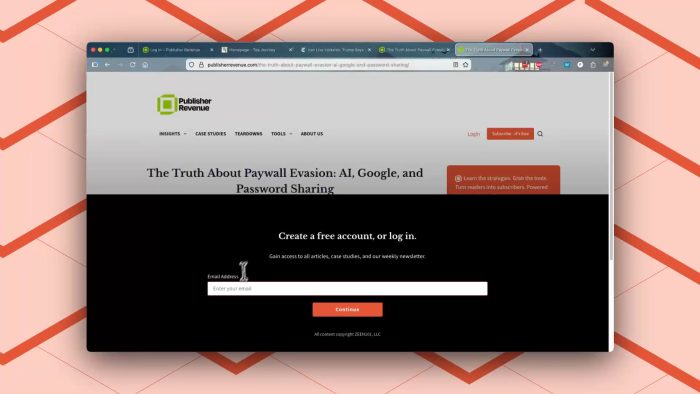
The registration wall also gets more readers into that position. Across nine Leaky Paywall publishers using the same registration wall after one free article, 3.2% to 6.7% of readers who saw it signed up. Newsletter popups convert 0.9% to 1.45%.
That’s two to seven times the signups, because a popup only asks and a registration wall requires.
Those registered readers pay at a much higher rate. Across the publishers we work with, a paywall shown to registered, nurtured readers converts 3% to 8%. The industry baseline for a cold paywall shown to strangers is 0.5% to 2%.
Piano’s benchmark data shows the same gap: 0.22% for cold paywalls versus 9.88% for registered users.
In a Mather Economics study of one publisher’s registration wall launch, known readers grew 5.8x and digital-only subscribers grew 60% in the first year. Page views held steady. Subscriber growth took about three months to show up, which is why we recommend giving any wall 90 days before you judge it.
Your Login Page Is a Checkout Page in Disguise
Your login page reaches some of your highest-intent readers, and on many sites it’s a bare form.
Northshore Magazine, a regional lifestyle title on the North Shore of Massachusetts, rewrote its login page as a sales page. It added a tagged subscribe link so it could track results.
In 30 days, that one link produced 15 conversions. Only its Instagram link-in-bio drove more (22). By revenue, though, the login page beat every source it had, including paid Facebook, Taboola, the newsletter, and renewal emails.
Why? Plan mix. Readers who came through the login page bought annual and print-plus-digital plans. Readers from social bought monthly.
It’s one publisher and a small sample, so treat it as a signal. Testing it on your site costs one paragraph of copy and one link.
Keeping Them Paying Is a Checkout Problem Too
Every renewal is another checkout.
A reader doesn’t have to choose to leave for you to lose them. An expired or declined card does it for them.
What matters most is who creates the payment: your subscription platform or Stripe itself. Across the publishers we work with, platforms that sit in the middle and run their own retry logic see 6% to 10% involuntary churn a year. Native Stripe subscriptions run 4% to 7%.
Stripe’s Smart Retries use AI to pick the best time to retry a failed card, with a recommended default of 8 tries within 2 weeks. When retries run out, a recovery tool like ChurnBuster can win back another 10% to 15% of failed payments with a 30-day email sequence. Leaky Paywall creates native Stripe subscriptions, so both tools work as designed.
We cover the full playbook in How Newsletters Stop Silent Subscriber Churn.
Watch for card testing too. Fraudsters run stolen card numbers through checkout pages to see which ones work, flooding your account with failed charges. A captcha like reCAPTCHA or Cloudflare Turnstile on your signup and checkout forms, alongside the hCaptcha check Stripe runs behind the scenes, effectively stops it.
A Five-Minute Subscription Checkout Audit
Open a private browser window, on your desktop and then on your phone, and run these five checks on your own site.
- Interruption test. Count the pop-ups and prompts between landing on an article and reading it. More than one is too many.
- Requirement test. Start a subscription. Does anything stand between you and the card form besides your email?
- Domain test. Does the address bar change during checkout? Does the page still look like your site?
- Login page test. Visit your login page. Is there a clear, tracked reason to subscribe on it?
- Payment test. Ask your platform: who creates the payment, you or Stripe? Is there a captcha on your signup and checkout forms?
Fix the first failure you find before moving to the next.
Resources Mentioned
