
How a Fishing Publisher Built an AI-Proof Audience in One Quarter
The Fisherman tripled free registrations and boosted paid subscriptions by tightening their registration wall — a direct response to AI overviews draining their niche content.

Case Study Summary
- Publisher: The Fisherman (niche fishing, Northeast & Mid-Atlantic)
- Challenge: AI overviews siphoning niche fishing content, threatening the value of live reporting
- Solution: Tightened registration wall to hard-gate content and build a controlled audience
- Result: 3x increase in free registrations, paid subscriptions trending upward
THE PUBLISHER
The Fisherman has been the go-to fishing authority for Northeast and Mid-Atlantic anglers for years. They cover ocean and inshore fishing from Maine down through Connecticut, across Long Island, and from New Jersey to Delaware with three dedicated print editions serving each region.
What makes them stand out isn’t just their coverage area. It’s their real-time reporting. Captains on the water text in live fishing reports throughout the day — what they’re catching, where the fish are biting, what’s working. It’s the kind of boots-on-the-ground (or hulls-in-the-water) intelligence that no algorithm can replicate.
They’ve also built a strong digital presence alongside their print editions, and they were already leaning into online subscriptions. By most measures, The Fisherman was doing everything right.
Then AI showed up.
THE CHALLENGE: WHEN AI COMES FOR YOUR NICHE
There’s a common assumption among niche publishers: AI overviews won’t affect us. General news? Sure. But hyper-specific regional fishing reports? That’s too niche for Google’s AI to bother with.
The Fisherman tested that theory with a simple search: “Where is the best fishing today off of Long Island?”
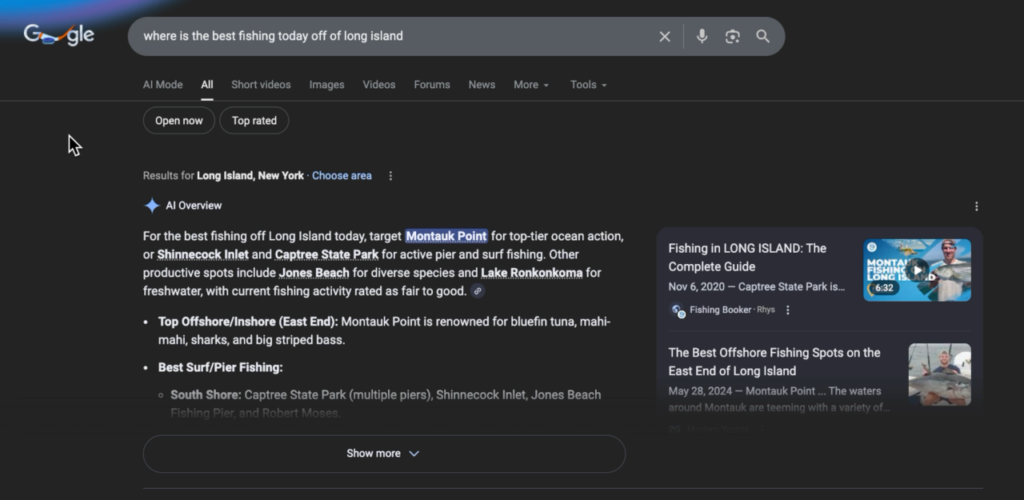
The result was an AI overview stuffed with information — Montauk Point, Shinnecock Inlet, Captree State Park, Jones Beach — pulling from multiple sources and presenting it as a complete answer. The Fisherman did show up in one of the cited links, buried deep in the overview. But look at the bigger picture: a reader searching for that information gets an answer without ever visiting a publisher’s website.
This is the zero-click search problem that’s hitting publishers across the board. The numbers paint a grim picture industry-wide: Google search traffic to publisher websites has dropped roughly 30–38% in the U.S. Click-through rates on AI-mode queries have fallen by 61%. Users are spending three times longer in AI mode than in traditional search, asking follow-up questions and getting answers — all without clicking through to the source.
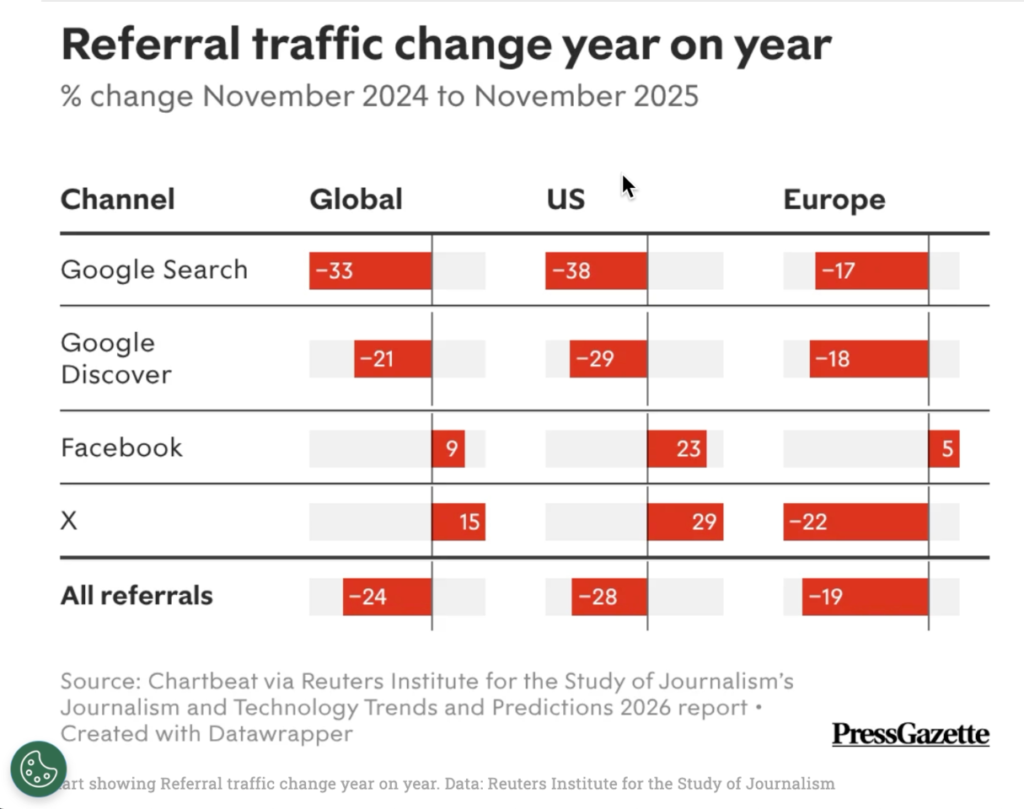
For a publisher whose competitive advantage is live, real-time fishing intelligence from actual captains, watching AI package that content into a summary and serve it to their audience is a gut punch. The content that makes The Fisherman valuable — the same content that took years and real relationships to build — was being scraped, summarized, and delivered for free by a search engine.
And the licensing deals being floated by AI companies? A fraction of a penny per content interaction. That’s not a revenue model. That’s a rounding error. As one Nieman Lab analysis put it bluntly: publishers will see no meaningful AI licensing revenue.
Even for a niche publisher with highly specialized, real-time content, the threat was clear. If AI can summarize “where to fish off Long Island today,” it can eventually summarize anything. The buffer niche publishers enjoy is a matter of time, not immunity.
THE DECISION: CONTROL WHAT YOU CAN CONTROL
The Fisherman could have chased the emerging “AI optimization” playbook — targeting “share of answer” in AI overviews, trying to improve “citation visibility,” optimizing for “brand recall” in zero-click results. That’s what some industry voices were recommending.
They chose a different path: forget about optimizing for AI and focus on their audience.
The logic is straightforward. As a publisher, you have two superpowers — your content and your audience. AI can scrape your content. It can’t scrape your subscriber list. So the play is to make your audience the moat, not your search rankings.
The Fisherman had already been running a registration wall, but they decided to tighten it significantly. Instead of letting readers browse freely and hoping they’d eventually sign up, they moved to a hard gate: you see the headline, you see a registration prompt, and you provide your email to read the story.
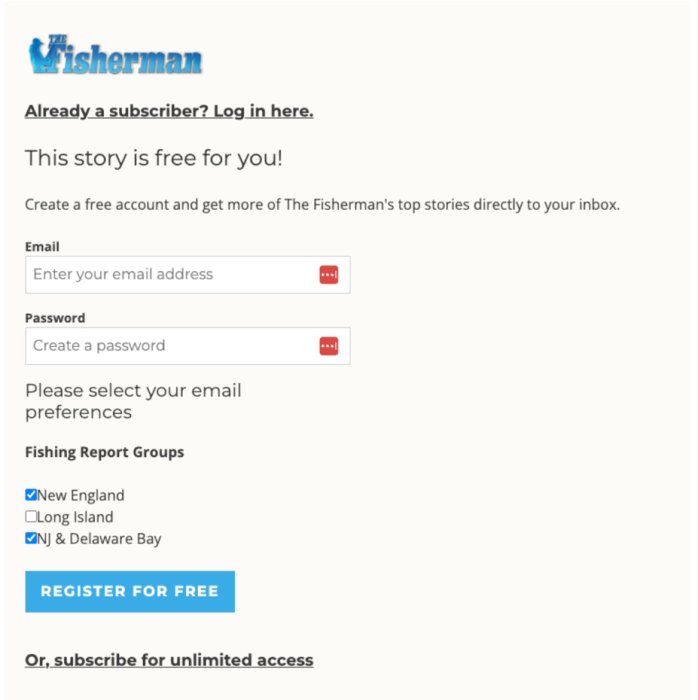
No content without an email address. Fair trade.
The registration prompt itself was clean and strategic. Email and password fields, plus checkboxes for their three regional newsletters — New England, Long Island, and New Jersey/Delaware. A reader registers once and immediately gets plugged into the newsletter that matches their fishing region.
THE RESULTS: WHAT HAPPENS WHEN YOU TIGHTEN THE WALL
The Fisherman tightened their registration wall in January 2025. The impact was immediate and dramatic.
Free registrations tripled. The growth wasn’t gradual; it was a sharp, visible spike from the moment the tighter wall went live. What had been a steady trickle of signups turned into a consistent stream.
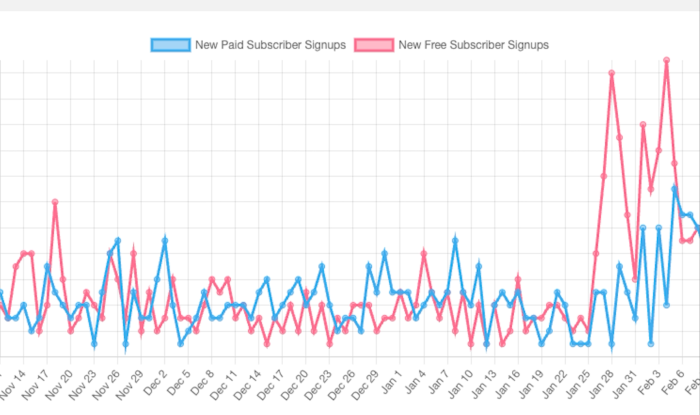
Paid subscriptions also climbed. This is the part that surprises publishers who are nervous about gating content. Tightening the wall didn’t push people away — it forced a decision. Readers who valued the content enough to register were also more likely to convert to paid over time. The registration wall became the top of a real conversion funnel instead of a polite suggestion.
Here’s the key insight: the readers who bounce at a registration wall after one article were never going to become subscribers. The readers who type in their email address and pick their regional newsletter? Those are your future paying customers. A registration wall doesn’t lose you customers — it identifies the ones you actually have.
WHY THIS WORKS: THE DOMINO EFFECT
When The Fisherman’s email list started growing at 3x the previous rate, it didn’t just mean more email addresses in a database. It triggered a cascade of benefits.
Newsletter drives return traffic. Every newsletter sent is an invitation back to the website — one that bypasses Google, AI overviews, and social algorithms entirely. Readers click through from their inbox directly to the content. No intermediary. No zero-click problem.
Bigger list attracts sponsors. Sponsors want engaged, targetable audiences. A growing email list segmented by fishing region is exactly the kind of asset that commands premium sponsorship rates.
More registrations fuel paid conversions. With upgrade messaging built into the free newsletter experience, every send is a touchpoint nudging registered readers toward a paid subscription. Publishers using this funnel typically see registered readers convert to paid at 3–5x the rate of cold traffic.
Content stays protected from AI. A hard-gated article gives AI crawlers nothing to scrape beyond a headline. The Fisherman’s live fishing reports — the crown jewel of their content — stay behind the wall, available only to registered and paid readers. That’s content control in the AI era.
Traffic actually goes up. This is counterintuitive, but publishers who aggressively grow their email list through registration walls consistently report significant traffic increases within a year, driven by newsletter click-throughs and engaged readers returning on their own.
THE BOUNCE RATE TRAP
One cautionary note: another publisher put up a registration wall, saw registrations start rolling in, and then took the wall down. Why? Someone up the chain noticed bounce rates had increased in Google Analytics and panicked.
This is a trap. Of course bounce rates go up when you gate content — visitors who don’t register leave. But those visitors were never going to subscribe or pay. They were anonymous traffic generating fractions of a penny in ad impressions at best.
The math is simple: a highly engaged registered reader who comes back through your newsletter, reads your content, and eventually pays $9 or $19 a month is worth infinitely more than a thousand anonymous visitors who bounce after scanning a free article.
Registration walls trade vanity metrics for real ones.
THE ROAD AHEAD
The Fisherman is still running a metered model on some content, which means Google can still index and surface their articles in search results. That’s intentional — for now. They’re still benefiting from SEO and social sharing while their list grows.
But here’s the strategic trajectory: as the email list and paid subscriber base continue to build, the need for Google traffic diminishes. At some point, The Fisherman will likely hard-lock the entire site. Their audience will be large enough and engaged enough that the trade-off — losing SEO visibility in exchange for complete AI protection — makes sense.
It’s worth noting that Google’s search bot and AI overview bot are the same system. You can’t block one without blocking the other. So when a publisher is ready to lock AI out, they’re also locking out traditional SEO. That’s only a viable move when your owned audience is strong enough to sustain your traffic independently.
The Fisherman is building toward that tipping point — and their registration numbers suggest they’ll get there faster than most.
KEY TAKEAWAYS
- Niche doesn’t mean immune. AI overviews are already surfacing hyper-specific niche content. If someone can Google a question your content answers, AI can package that answer without a click-through. The buffer niche publishers enjoy is temporary.
- Registration walls are AI defense and audience offense at the same time. Gating content behind a free registration blocks AI crawlers from scraping your full articles and builds an email list you own and control. That list becomes your primary distribution channel — one that no algorithm change can take away.
- Tighter walls produce better results, not worse. The Fisherman tripled registrations and grew paid subscriptions by making their wall more restrictive, not less. Publishers who are nervous about gating content are typically overvaluing anonymous traffic and undervaluing engaged readers.
- Your email list is the moat. In a world where AI can summarize your content and Google traffic is declining, the only audience you truly control is the one on your email list. Every strategic decision should funnel toward growing and nurturing that list.
The Fisherman is a Leaky Paywall publisher. Their registration wall, content metering, and subscription infrastructure are powered by Leaky Paywall
