
KB Independent’s Hybrid Revenue Playbook
How a Florida nonprofit news outlet moved past donations to a hybrid model with free registrations, paid memberships, and group subscriptions that's outperforming donation-only by far.

Episode Summary
- KB Independent moved through three phases: donation-only, free registration with renewal friction, and a hybrid model with free AP content plus paid hyperlocal coverage.
- Every page on the site (free or paid) sits behind a free registration wall, so even the giveaways build the email list.
- Paid subscriptions unlock revenue donations can’t reach: gift subs, group subs for local businesses and institutions, and newsletter ad placements.
- The hybrid donations + memberships + paid subs model outperforms donation-only by a wide margin.
The Breakdown
Most nonprofit news publishers stay stuck on a donate button and a grant cycle. KB Independent in Florida shows a different path.
The Key Biscayne Independent started donation-only. No memberships, no subscriptions, just a click-to-give button on the site. As Tyler Channel points out in this conversation with Pete Ericson, that setup leaves recurring revenue on the table and pins the publication’s survival to whatever foundation or super-fan keeps writing checks.
KB Independent took a different route. Three phases later, they’re running a hybrid model that pulls in donations, free registrations, and paid memberships at the same time, and the numbers are up.
Phase 1: Donation-only (the trap)
The donate button alone is not a revenue engine. You’ll get a few super-fans. You won’t sustain a publication.
For nonprofits worried about staying compliant, a membership play is usually cleaner than a transactional for-profit subscription. You’re trading content access for recurring support. That’s still recurring revenue.
Phase 2: Free registration with renewal friction
KB Independent introduced a clever bridge using an earlier version of List Builder. One free article, then a sign-up wall. After registering, you got limited-time free access. When that window expired, you had two options: renew the free access (a small link tucked into the FAQ) or pay for a membership and stop the cycle.
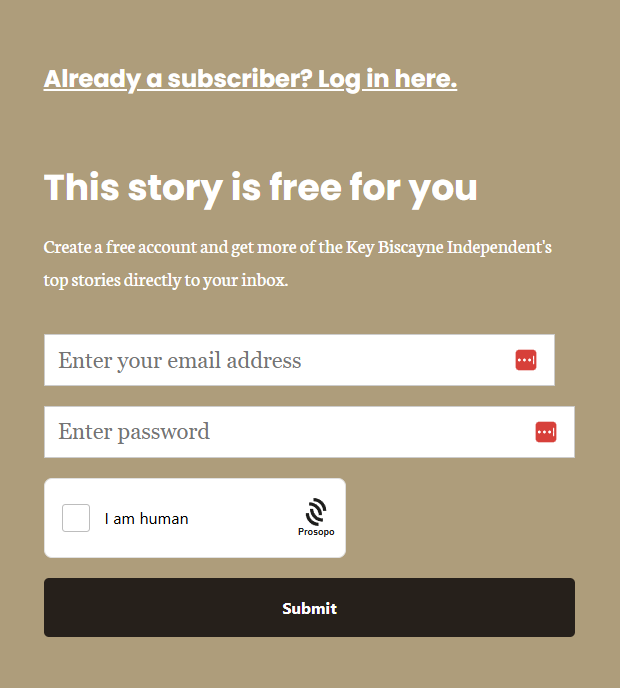
The renewal trick wasn’t promoted on the subscribe page. Readers still found it. Some kept refreshing forever. Others got tired of the loop and paid the $99 to be done with it.
That’s friction in time, not friction in price. People will pay for convenience.
Phase 3: The current hybrid model
Today the setup looks like this:
- AP wire content (Florida-relevant): always free, but still requires a free registration to read
- Hyperlocal Key Biscayne reporting: free registration first, metered, then a paid membership prompt to keep reading
- Donations: still active alongside both
The key move: the free registration sits on every page. AP content is free, sure. But you give an email to read it. That email goes into the newsletter list. The newsletter goes to inboxes. The inboxes get nudged to upgrade.
Why register for free content?
Many publishers get squeamish here. If it’s free, why ask for an email?
Because if a reader wants the article, they’ll give you the email. Cutting the registration loses you nothing on conversion and costs you the entire email list. The email list is the direct marketing tool that brings readers back to see upgrade prompts again and again.
That’s how you stop being dependent on Google updates and social algorithms you don’t control.
The pricing page
KB Independent’s subscribe page has one thing right: singular focus. Three bucks for the first month, then $10/month after.
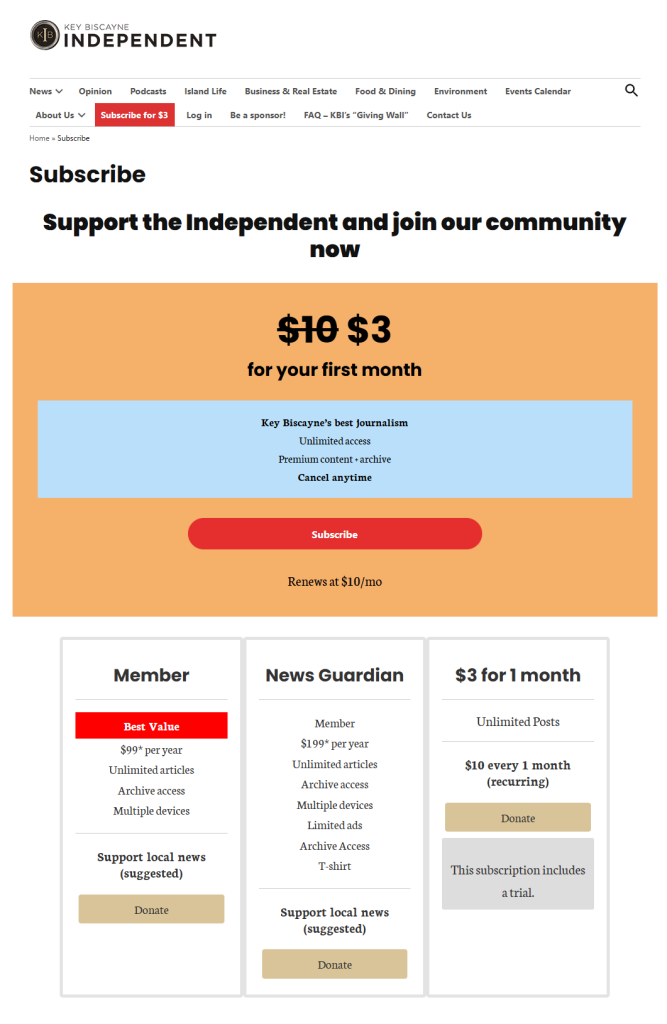
One small adjustment Pete recommends: discount time, not money. Instead of $3 for one month, try $10 for two or three months, then $10/month after. Same total introductory cost. Different signal. You’re giving free trial time, not training the reader to expect a permanently cheap product.
That’s why “99 cents for three months” is a trap. It teaches your audience the content is worth pennies.
What paid subscriptions unlock that donations can’t
Once you’re charging for access, new revenue streams open up:
- Gift subscriptions. Existing subscribers buy access for friends and family. You can’t gift a donation.
- Group subscriptions. Local libraries, schools, government offices, cafes, real estate offices. Bulk access for an organization at a single price. KB Independent already promotes this.
- News Guardian / supporter tiers. A higher-priced tier for readers who want to give more. KB’s version includes one reader-requested article per year.
- Newsletter sponsorships. Ads placed inside your daily newsletter, around your content, not in standalone ad-only sends.
None of these exist if you’re donation-only. They all become possible the moment you have a paid subscription product.
What’s actually working
Tyler works with a lot of news publishers across donation, subscription, and hybrid models. KB Independent’s current setup, in his read, is closer to what for-profit subscription publishers in similar-sized communities pull in.
For a nonprofit. Without giving up donations. Without abandoning the mission.
That’s the unlock for nonprofit publishers who think recurring revenue is a for-profit problem.
Key Takeaways
- Donation-only ties your survival to grants and super-fans. A membership play adds recurring revenue without forcing a tax-status conflict.
- Friction in time converts better than friction in price. Make readers do something repetitive to keep free access, and a meaningful percentage will pay to skip the loop.
- Your audience will surprise you on what they’ll register for. Don’t assume which articles deserve a registration wall. Put it on everything and let the data tell you.
- Group subscriptions are an underused revenue line. Local libraries, schools, government offices, and small businesses all want bulk access. You only get to sell it once you have a paid product.
“If you’re not at least doing some sort of membership play, you’re most certainly leaving money on the table as far as recurring revenue is concerned.”
Tyler Channel
Try This Week
Put a free registration wall on your free content.
If you’re a nonprofit (or any publisher) giving content away, capture the email at minimum. The reader still gets the article. You get the email address that pulls them back tomorrow, next week, and every newsletter send after that.
Bonus: Pick one content category that’s currently completely open and add the free registration there first. Watch what happens to your list growth in 30 days.
Watch the Episode
Listen on Paywall Podcast
Resources Mentioned
